September 3, 2026
Döner Knife – Everything You Need to Know About Döner Blades
What is a doner knife?
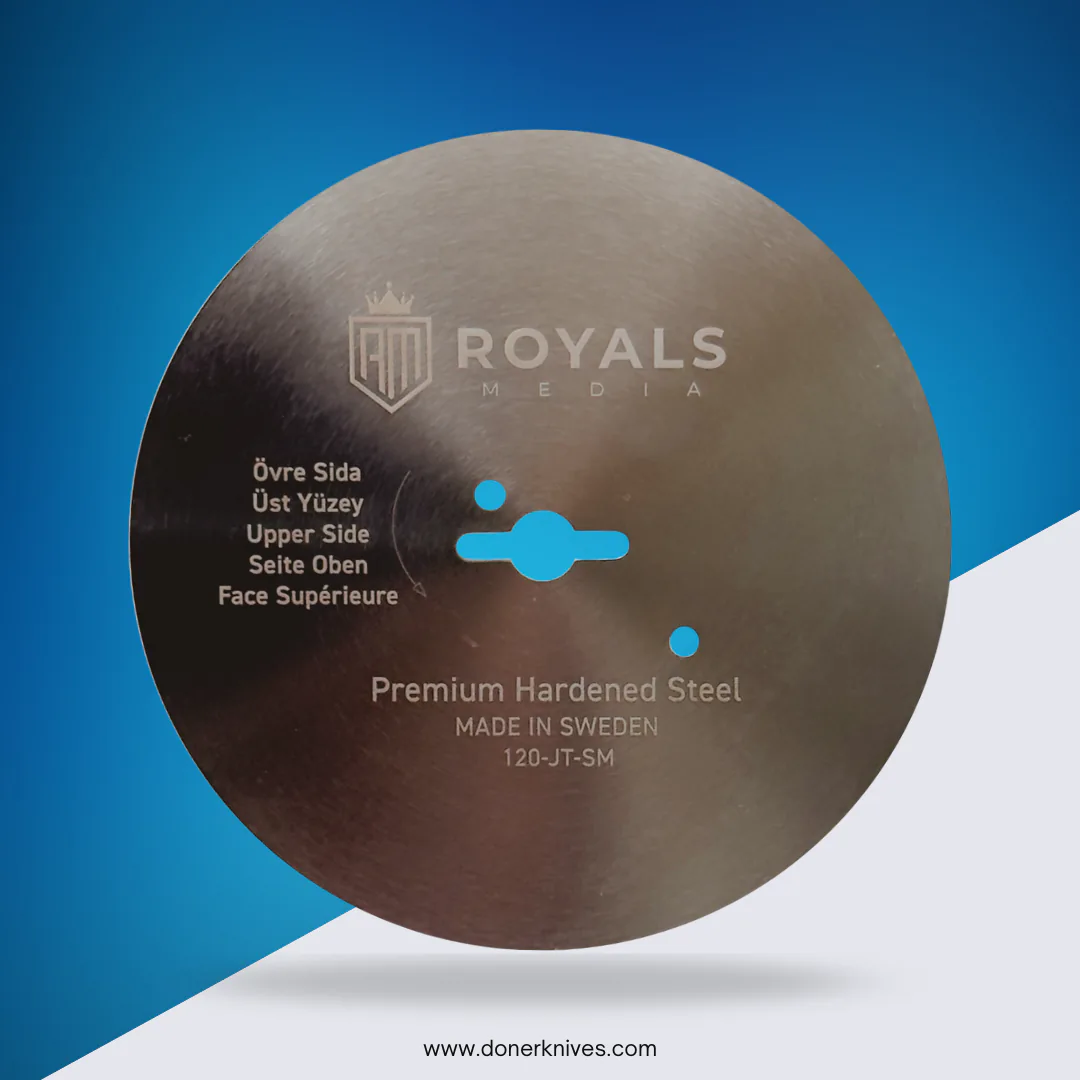
A doner knife is the circular steel blade that drives your electric doner slicer – but it's easy to think it's a handheld knife. It isn't. The blade is a round disc with no handle, tip, or spine. The entire circumference forms the cutting edge, and the central hole is what holds the blade in place on the machine.
Because the blade rotates against the meat, it cuts thin, even slices of doner meat – and the choice of blade determines both the quality of the slices and how long your machine can run without interruption. All blades in our range are made of hardened stainless steel, which provides long-lasting sharpness and resistance to rust and wear.
There is no one-size-fits-all solution. The blade diameter – 80, 90, 100, 120, or 140 mm – is determined entirely by your machine model, not personal preference. The mounting also varies: some blades have a keyhole fitting (Universal), others have a round centre hole (Dost), and some are brand-specific, such as Jet and Tandir.
Before buying a new blade, it's therefore important to know exactly which diameter and fitting your machine requires. Measure your old blade or check the machine brand in our compatibility guide – then you'll find the right doner blade the first time.
How a doner slicer works
A doner slicer is an electric machine that rotates a circular blade at high speed to cut thin, even slices of meat from a vertical rotating spit. Unlike a regular knife, where you control the cut yourself, the slicer does the work for you – the blade spins continuously while you guide the spit forward, either by hand or with a manual feed.
The doner knife itself is a round disc of hardened stainless steel with a sharp edge around the entire circumference. When the motor drives the blade, the edge rotates against the meat surface and cuts off thin strips with minimal pressure. This preserves the meat's juiciness and ensures an even result every time. Many machines also have a built-in sharpening stone, so you can hone the blade without removing it – a quick turn against the stone restores a fresh edge.
The blade is attached in the centre via a hole that fits the machine's drive shaft. When replacing the blade, it's crucial to ensure it sits correctly and is balanced; otherwise, it can vibrate or cut unevenly. With proper care and a sharp blade, every slice will be perfectly thin – just like from your favourite kebab restaurant.
Different diameters – which one fits your machine?
The diameter of your doner knife is determined entirely by your machine – it's not a matter of preference but of mechanical fit. A 80mm Universal – Smooth or serrated blade fits machines from Ceylan and Gurden, while Potis machines accept either 80 mm or 140 mm Universal blades. Smaller machines with compact spits use 80 mm or 90 mm blades, while larger, high-volume machines require 120 mm or 140 mm blades to cover the whole meat stack.
For Dost machines, you need 90 mm or 120 mm Dost blades, and for larger models, 120 mm Dost. Jet machines use 120 mm Jet blades with a specific fitting. Tandir machines take 100 mm or 120 mm Tandir blades. For Alkadur, IDM, and Korkmaz, choose 140 mm Universal blades with 3 holes, while Atalay requires 140 mm Universal with 4 holes. As you can see, the number of holes is decisive – measuring the old blade's centre hole and bolt pattern is always the safest approach.
A common misconception is that a larger blade gives better cutting results. That's not the case – an oversized blade will hit the machine's guard or cut unevenly, while an undersized blade won't reach across the meat surface. If your machine isn't listed above, measure the old blade's diameter, centre hole size, and hole spacing. You can also send a picture of the fitting and we'll help you match the right doner knife.
Also note that 140 mm Universal blades come in 2-, 3-, and 4-hole versions. Always measure the bolt circle – two machines with the same diameter can have different hole patterns. Choosing the right diameter from the start gives you even cutting, less waste, and a blade that sits securely throughout the entire service. When in doubt: measure first, order second – it saves both time and money.
Smooth or serrated edge – which should you choose?
When deciding between a smooth and a serrated edge, it's not about which is "best" but about what type of meat you're cutting and its temperature. Both edge types are available throughout our range, and both are made of hardened stainless steel.
Smooth edge – for precision and fine slices
A smooth edge produces a clean, even cut without tearing the meat's fibres. This is especially important when serving thinly sliced doner that should be tender and juicy. The smooth edge works best on meat that is at room temperature or has just been removed from the machine, where resistance is low. The result is thin, elegant slices with a fine surface – exactly what customers expect from a classic doner. If you prioritise a silky texture and a professional presentation, a smooth edge is your choice. You can read more in our guide to 90 mm smooth doner blades.
Serrated edge – for chilled meat and firm grip
A serrated edge works like a saw: the teeth grip the surface and cut through even when the meat is firmer or straight from the fridge. This reduces the risk of the blade sticking or tearing the meat. The serration gives a slightly coarser cut, but that's often an advantage when working with semi-frozen or tightly packed meat rolls. Many prefer a serrated edge because it feels more efficient during longer serving sessions.
How to decide
- Smooth edge – for tender, room-temperature meat and maximum slice quality.
- Serrated edge – for chilled, firmer meat and a more aggressive cut.
Whichever you choose, it's the machine's diameter that dictates the blade – not the other way around. For a 90 mm Universal machine, you can compare the smooth and serrated versions to see which suits your service best. Many restaurants keep both on hand and switch depending on the meat's temperature. Your doner knife should be a tool that adapts to your kitchen – not the other way around.
Fittings and mounting of doner blades
Mounting a new doner blade is straightforward once you know which fitting your machine has. Always start by switching off the machine and unplugging it – safety comes first.
Identify your fitting. There are three main types: keyhole (Universal), round centre hole (Dost), and brand-specific fittings (Jet and Tandir). 140 mm blades are secured with bolts through 2, 3, or 4 holes. Check your old blade: the diameter, centre hole shape, and bolt pattern determine which blade you need. If you're unsure, measure carefully or send a picture of the fitting and we'll help.
Mounting step by step:
- Clean the mounting surface on the machine from grease residue.
- Place the blade with the smooth side against the machine's flange. The centre hole must sit perfectly over the shaft.
- For Universal models (keyhole): slide the blade so that the narrow part of the keyhole locks against the pin.
- For Dost and brand-specific models: ensure the hole and any guide pins fit exactly.
- Tighten bolts or nut in a criss-cross pattern for even pressure. Don't overtighten – the blade should sit firmly but not deform.
For 140 mm Universal with 2, 3, or 4 holes, the same principle applies: follow this guide for bolt mounting to see exactly how to centre the blade correctly.
After mounting, spin the blade by hand one full turn. It should rotate freely without play or vibration. A misaligned blade produces uneven slices and strains the motor. Remember that a doner knife must always sit in exactly the right position – that's the entire difference between perfect slices and shredded meat.
Care and cleaning of your doner knife
A doner knife is a precision tool that delivers the best results when properly maintained. Clean the blade immediately after each shift – grease and meat residue come off most easily then, without needing to scrub hard.
Hand washing is a must. The dishwasher's aggressive detergent and high temperature attack the edge and significantly shorten the blade's lifespan. Instead, wash by hand in lukewarm water with a mild dish soap and a soft sponge. Avoid steel wool and abrasive scouring pads that can scratch the surface.
Always dry the blade thoroughly with a soft cloth immediately after washing. Moisture that dries on can cause discolouration on the hardened stainless steel. Store the blade dry and protected, preferably in its original packaging or in a designated spot where it can't knock against other objects.
Check the edge regularly for damage such as nicks or wear. A sharp doner knife cuts cleanly and evenly – a dull or damaged edge gives poorer slices and strains the motor in your slicer. Always handle the blade with respect for the edge; read our safety tips for handling and storage for more guidance.
With proper care, your blade will retain its sharpness longer and give you even, thin slices every time.
When should you replace your doner blade?
A doner blade is a wear part, not an eternal machine. Even though a blade in hardened stainless steel can take a lot, the edge wears down from friction against the meat – especially if you cut frozen or tightly packed meat. Here are the clearest signs that it's time to replace:
- Poorer cutting results: The meat tears or becomes uneven instead of being cut into thin, even slices. You notice you have to press harder against the meat.
- Visible damage: Inspect the edge regularly. Small nicks or a shiny, rounded edge are signs that the steel has lost its sharpness.
- Increased heat or vibration: If the machine sounds different or vibrates, the blade may be dull or have sustained damage affecting its balance.
A rule of thumb is that a blade used daily in a restaurant should be replaced every 4 to 6 weeks. At low volume, it can last considerably longer. Regardless of which type of doner knife you use – serrated or smooth – it's more important to replace it in time than to wait until it becomes urgent. A dull blade not only gives poorer food quality; it also increases the risk of accidents because you tend to use more force. Dropped the blade on the floor? Replace it immediately – an invisible crack can cause the blade to break during rotation.
Material and quality – why we choose hardened stainless steel
When you hold a doner knife in your hand, you notice the difference immediately. Why? Because every blade in our range is made of hardened stainless steel. That's not a random choice – it's about giving you a slicer that withstands daily use without losing its edge.
Hardening makes the difference. Through a controlled heating and cooling process, the steel becomes significantly harder than regular stainless steel. The result is a blade that cuts cleanly through both warm and cold meat without deforming. You get thin, even slices day after day.
Stainless steel for hygiene and durability. Stainless steel is corrosion-resistant, which is crucial in an environment with lots of moisture and meat juice. The blade won't rust, doesn't affect the taste, and is easy to keep clean. You don't have to worry about discolouration or wear that degrades the quality of your servings.
A common misconception is that all steel blades are equivalent. They're not. Our blades are designed to maintain the edge significantly longer than cheaper alternatives. Read more about the difference between hardened and regular steel to understand why the material choice affects both taste and economy in the long run. When you choose a blade of hardened stainless steel, you're investing in a tool that performs at its best – every day.
Frequently asked questions about doner knives
How do I know which doner knife fits my machine?
Start by measuring the diameter of your old blade – it's decisive. The diameter is determined entirely by your machine, not personal preference. The manufacturer's brand on the machine also helps: for Dost, 90 mm or 120 mm Dost blades fit; for Jet, 120 mm Jet; and for Tandir, 100 mm or 120 mm Tandir. For Alkadur, IDM, and Korkmaz, use 140 mm Universal with 3 holes, while Atalay requires 140 mm Universal with 4 holes. Ceylan and Gurden take 80 mm Universal, and Potis takes either 80 mm or 140 mm Universal. Is your machine not on the list? Then measure the old blade's diameter, centre hole, and bolt pattern – or send a picture of the mounting and we'll help.
What's the difference between smooth and serrated edge?
A smooth edge gives an even, thin cut – perfect for tender, room-temperature meat where you want a clean slice without fraying. A serrated edge is better for firmer or fridge-cold meat, because the teeth grip and cut through the surface without crushing the fibres. Many use smooth for daily production and serrated for the morning's cold roast.
Can I wash the blade in the dishwasher?
No, never. The dishwasher's aggressive detergent attacks the edge and destroys the hardening. All our blades in hardened stainless steel should be hand-washed immediately after use and dried thoroughly. It takes two minutes and significantly extends the lifespan.
Are all doner knives round discs?
Yes – a doner knife is a circular steel blade with no handle, tip, or spine. The entire circumference is the cutting edge, and the centre hole holds the blade in place on the machine. There are no handheld versions in our range.
Which diameter should I choose if I'm unsure?
If you can't find your machine in the list above: measure the existing blade. The diameters we offer are 80, 90, 100, 120, and 140 mm – nothing else. The right diameter is determined by the machine, not by taste. An incorrect diameter gives poor cutting performance and can damage the mounting. When in doubt, always measure – or contact us with a picture of your current doner knife and we'll sort it out directly.
Summary – find the right doner blade for your machine
Choosing the right doner knife isn't about taste – it's about your machine. Start by measuring the diameter of your old blade and checking the mounting. Universal models with a keyhole fit most machines, while brand-specific blades like 120mm Dost – Smooth or 120mm Jet – Serrated are designed for an exact fit.
Also consider how you cut: a smooth edge gives even, thin slices on room-temperature meat, while a serrated edge handles cold or firmer raw material better. Whichever you choose, you get hardened stainless steel that holds its edge for a long time – provided you wash it by hand.
Unsure which blade your machine takes? Measure the old blade's diameter, centre hole, and screw holes, or send a picture of the mounting. Then you'll get the right part the first time – without guesswork.