September 17, 2026
140mm Donner Blades for Dast Machine with Mounting Holes: The Comprehensive Guide
Introduction to Circular Doner Knives
When it comes to slicing meat roasted on a doner machine, the quality of the circular blade is what makes the difference between clean, even slices and shredded meat. If you are looking for 140 mm doner blades for a Dost machine with mounting holes, you are in the right place, as this blade is specifically designed to provide high cutting precision with complete stability on the shaft, ensuring smooth operation throughout the working period. Unlike manual knives, this blade is a fully circular steel disc, without a handle, teeth, or spine, where the entire circumference forms the cutting edge, whilethe central hole and mounting patterns secure it firmly in place. This engineering design makes it an indispensable professional tool in any commercial kitchen. For a deeper understanding of how to choose the right blade and care for it, you can refer to a comprehensive guide to doner blades, which explains in detail the types of edges and mounting methods, helping you make the right decision for your machine.
140 mm Doner Blades for Dost Machines: The Reality of Compatibility
When discussing 140 mm doner blades for Dost machines with mounting holes, it is essential to clarify the reality of compatibility precisely, because an error in selection means work stoppage. A blade with a diameter of 140 mm is not merely a larger option, but rather a completely different mounting system from smaller models. In this size, the machine does not rely on a simple circular central hole, but rather on a pattern of side holes (2, 3, or4 holes) that secure the blade to the rotating shaft. It is important to know that famous "Dost" machines do not use this size in their standard models (ranging between80 and120 mm.). Instead, 140 mm blades are specially designed for Turkish brand machines such as Alkadur, IDM, and Korkmaz ((with three holes)) andAtalay((with four holes)), while some Potis models also use this size. Therefore, if you own a "Dost" machine and wondered about the possibility of installing a140 mm blade, the answer depends on the shape of the mounting shaft in your machine, not just the commercial name. The ideal solution is to inspect the old blade: measure the outer diameter, then the number of mounting holes and their spacing. You can check options for universal 140 mm blade with 2 holes or with 3 holes or with 4 holes to match the correct pattern. To learn more about selection criteria, see guide to choosing the right doner blade. The golden rule: do not buy by name, but measure first.
Mounting Hole Systems in Doner Blades
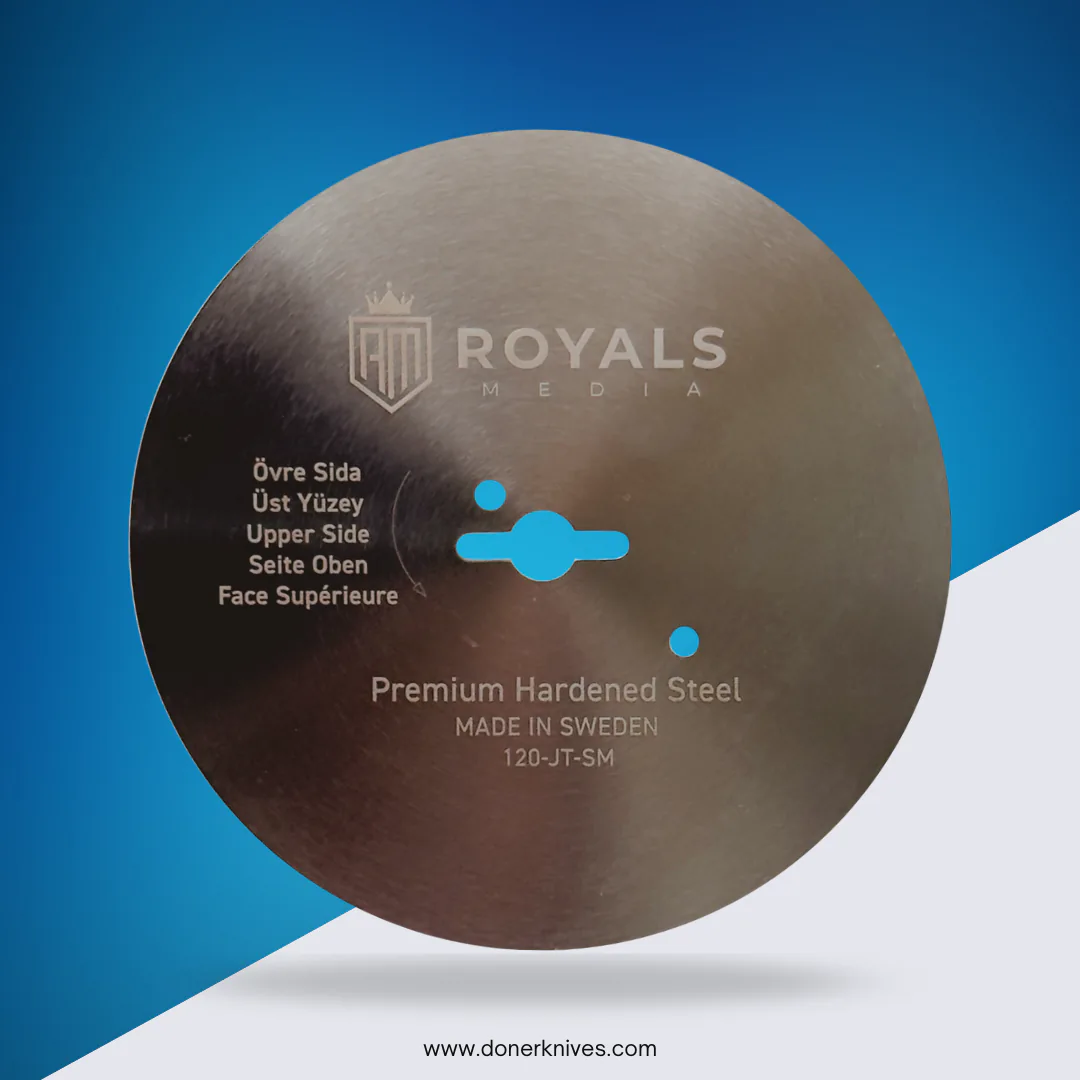
When searching for a replacement blade for a doner machine, the mounting hole system is the first thing to inspect, as it is the only connection point between the blade and the rotating shaft. It is not enough that the outer diameter matches, but the holes in the center must align with the mounting mechanism in your device with utmost precision. Mounting systems vary primarily between three patterns: the simple circular hole that mounts on a smooth shaft with a side screw, the keyhole opening that slides onto a special pin, and the threaded holes system that is secured with screws passing through the blade body. As for the larger type, namely 140 mm doner blades for Dost machines with mounting holes, it mostly relies on the multi-screw system. When measuring the mounting system, pay attention to three critical dimensions:the diameter of the central hole, the distance between centers of opposing holes((PCD)), and the number of holes themselves. A blade with a diameter of140 mm may come with two, three, or four holes, and each pattern corresponds to a specific machine model. For example, Alkadur andIDM machines use the three-hole pattern, while Atalay prefers the four-hole pattern. If you are unsure of the pattern, the best solution is to measure your old blade or send a photo of the rear area of the machine. Do not attempt to install a blade whose holes do not match, because the vibration resulting from mismatch will damage the shaft and affect cutting quality. Remember that a universal blade with 2 holes is a flexible option, but it does not replace precise dimension matching.
Edge Types: Smooth vs. Serrated
When choosing a doner blade, the edge type is one of the fundamental decisions that affects cutting quality and work speed. The 140 mm doner blades for Dost machines with mounting holes come with two main options:the smooth edge and the serrated edge, each with a specific function. A smooth edge produces thin, even meat slices with a perfectly smooth surface, preserving the meat's juiciness and appealing appearance. These blades suit tender meats roasted at medium temperatures, and are preferred by restaurants serving classic doner sandwiches. It is recommended to use a smooth universal 140 mm blade for best results with fresh, non-frozen meats. As for the serrated edge, it has sharp teeth that grip the meat surface and prevent slipping, making it ideal for frozen or heavily chilled meats, or when faster cutting is needed without much pressure. Some restaurants prefer the serrated edge because it stays sharp longer between sharpening sessions, and you can also check out the difference between hardened and stainless steel blades to choose the most suitable. The rule is simple: tender and fresh meat → smooth edge, cold or frozen meat → serrated edge. Your choice determines daily cutting quality.
Step-by-Step Guide to Measuring Your Old Blade
Before buying a replacement, precise measurement saves you the hassle of returning a product that does not fit your machine. Follow these four steps:
1. Measure the diameter (the basic size) Place the blade on a flat surface. Use a ruler or measuring tape to measure the distance from the outer edge to the opposite edge passing through the center. The result should be one of these values:80,90,100,120,or140 mm. Do not accept any other number. If the result is140 mm, you need the category of 140 mm doner blades for Dost machines with mounting holes or other140 mm category blades.
2. Determine the type of central mounting hole Look at the center of the blade. Is the hole perfectly circular? Or is it a keyhole shape? Or are there bolts passing through separate holes around the center? This determines the mounting type:((Universal, Dost, Jet, Tandir)).
3. Count the bolt holes((for 140 mm blades only)) If the diameter is140 mm, examine the number of separate holes designated for bolts. The number will be2,3,or4. This number is critical,, as a blade with3 holes will not fit a machine requiring4 holes. Compare the result with our products: 140mm universal – 2 holesor 3 holesor [4 holes](/en/product/140mm-universal-4-hole.
4. Take a photo of the mounting If you are not sure, take a clear photo of the blade face and the mounting area on the machine. This is the fastest way to get accurate confirmation. If you do not find your machine in the compatibility table, these measurements are the only reliable solution.
Caring for Doner Blades and Extending Their Lifespan
Proper care of a doner blade begins from the moment of installation and ends with storage. The first golden rule:hand washing only, because the dishwasher destroys edge sharpness due to chemical detergents and high heat. Wash the blade immediately after use with warm water and mild soap, then dry it immediately with a soft cloth to prevent fat from sticking and stains from forming. When installing,, ensure that the mounting holes align perfectly with the machine shaft, especially with 140 mm doner blades for Dost machines with mounting holes which require tight fastening without stressing the metal. Always use the original bolts and avoid over-tightening. To extend edge lifespan,, store the blade in a dry place away from other metal tools. You can place a protective cardboard sleeve between blades if you own more than one, such as a [smooth 120 mm Dost blade](https://donerknives.com/en/product/120mm-dost-smooth. Finally,, do not ignore signs of vibration during operation,, as it indicates mounting imbalance,, causing faster edge wear.
When Should You Replace a Doner Blade?
The timing for replacing a doner blade depends on observing its daily performance,, not on a specific number of hours. If you notice that slices have become thicker on the sides or torn instead of being smooth and even,, this is the first sign of losing sharpness. Likewise,, if you have to press harder on the machine lever to push meat toward the blade,, this is evidence that the edge no longer cuts efficiently. Among the clear signs also is the appearance of abnormal vibration in the machine or a squeaking sound during rotation,, which often indicates damage to the blade edge or imbalance. Do not wait until burnt fats accumulate on the edge,, as regular cleaning extends lifespan,, but it does not restore lost sharpness. When you notice these signs,, inspect the mounting hole system on the old blade,, as the new blade may be compatible without modification. To verify precise compatibility,, refer to our guide on [replacing a doner blade](https://donerknives.com/en/blog/doner-blade-replacement-tandir-90mm-no-modification. Always compare measurements before purchasing,, and ensure that the size of 140 mm doner blades for Dost machines with mounting holes matches your machine's holes perfectly.
Frequently Asked Questions about Doner Blades
Does a 140 mm blade fit a Dost machine?
No,, not directly. Dost machines rely on blades with a diameter of90 mm or120 mm exclusively,, not140 mm. The140 mm diameter is reserved for large brand machines such as Alkadur, IDM,, and Korkmaz((with a3-hole system)) or Atalay((with a4-hole system). If your machine is a Dost type,, search for a 120 mm Dost serrated bladeor [the smooth version](/en/product/120mm-dost-smooth. But if you own another machine,, measure the diameter of the old blade first.
What is the difference between the various mounting holes in 40 mm blades?
The holes determine compatibility with the machine shaft. 140 mm blades come in three patterns:2 holes,3 holes,and[4 holes](/en/product/140mm-universal-4-hole. They cannot be installed interchangeably,, so you must match the number of holes with the mounting shaft in your machine. If you are unsure,, take a photo of the shaft and compare it with the product.
Can I use a serrated blade to get smoother slices?
No,, the opposite is true. The serrated edge cuts frozen or firm meat forcefully,, but it leaves a rough surface. The smooth edge gives smoother and more cohesive slices for tender meats. Choose based on the condition of the meat you cut daily.
How do I clean a 140 mm doner blade with mounting holes?
Wash it by hand only with warm water and mild soap. Never place it in the dishwasher,, as chemical detergents attack the cutting edge and weaken it. Dry it immediately and apply a light layer of vegetable oil to prevent rust.
What should I do if I do not find my size in the table?
Do not guess. Measure the diameter of the old blade,, the diameter of the center hole,,and the hole pattern,, then contact us with a photo of the shaft and we will determine the correct blade for you from the range of 140 mm doner blades for Dost machines with mounting holesor others.
Summary: Choosing the Right Blade for Your Machine
When choosing a blade for your machine,, remember that the diameter is not a preference but is determined by the machine itself. Measure the diameter of the old blade,, the diameter of the mounting hole,,and the hole pattern before ordering,,or send a photo of the mounting if you are unsure. If your machine is a Dost type,, you will need a 120mm Dost – serratedor the smooth version,, while Atalay machines require the four-hole pattern. For best results with chilled meat,, choose the serrated edge which cuts without tearing fibers,, while the smooth edge gives you smoother slices for tender meats. Read our guide on 80 mm blades suitable for machines for a deeper understanding. Finally,, wash the blade by hand only and dry it immediately,, because the dishwasher ruins the edge. With the correct 140 mm doner blades for Dost machines with mounting holes,, you will get even cutting and a longer lifespan.