
October 10, 2026
100mm Doner Knife Blade Universal 4 Holes – Complete Guide
Introduction: What is a 100mm Doner Knife Blade Universal 4 Hole?
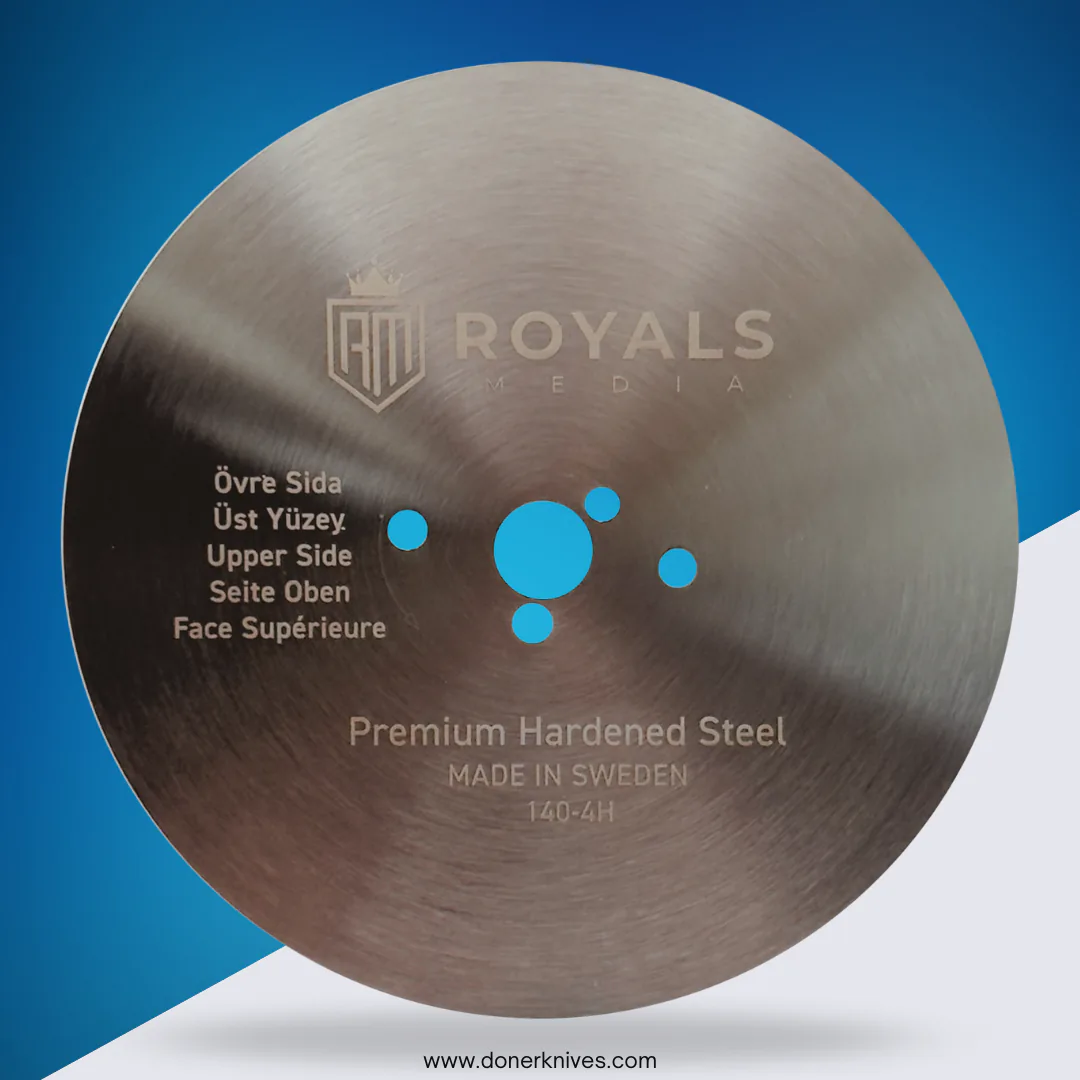
A 100mm doner knife blade Universal 4 hole replacement is the exact component you need when your current cutting wheel on your electric doner slicer is dull or damaged. It is a circular steel disc without a handle or point – the entire circumference is the cutting edge, and the central hole together with the mounting system holds the blade securely in place during rotation.
This blade is made of hardened stainless steel, providing both a long service life and a clean cut through your meat. With a diameter of exactly 100 millimetres, it is specifically designed for machines from the brand Tandir, where the universal 4-hole mounting guarantees easy installation without special tools.
You can choose between two edge types: a smooth blade for an even and gentle cut, or a serrated blade that is ideal for firmer or refrigerated meat. Whichever you choose, always make sure to clean the blade by hand – dishwasher chemicals attack the edge and significantly shorten its lifespan.
Before purchasing, double-check that your machine really uses 100 mm Tandir blades. If you are unsure, measure your old blade or contact us with a picture of the mounting and we will help you find the right replacement.
How the Universal 4-Hole Mounting System Works
Universal 4-hole refers to how the blade is attached to the machine's drive flange. Instead of a keyhole or a round centre hole, this blade has four symmetrically placed holes. The machine's flange has matching threaded pins, and you tighten the blade with four nuts or wing nuts. This creates a very stable and vibration-free grip, resulting in a more even cut even when the meat is firmer.
The advantage of four holes over two is that the force is distributed more evenly across the blade's surface. The risk of the blade wobbling or slipping is significantly reduced, which both protects the edge and extends the blade's lifespan. For you who use the machine daily, this means less maintenance and fewer adjustments.
Since the hole pattern is standardised for the 100mm diameter, a 100mm doner knife blade Universal 4 hole replacement fits directly on most machines from, for example, Atalay. You don't need any special tools – a regular socket wrench is enough. Just check that your machine's flange actually has four pins before ordering, because the Universal series is also available in 2- and 3-hole versions for 140 mm blades. Want to be completely sure? Measure the distance between the holes on your old blade or send a picture of the mounting, and you won't have to guess.
Compatibility: Which Machines Use 100mm Universal 4 Hole?
The 100mm blade is found in a specific machine family: Tandir. If you have a Tandir slicer, this is the right diameter, but it's important not to confuse it with other mounting systems. Tandir uses a keyhole mounting – not a round centre hole like the Dost models. Before ordering a 100mm doner knife blade Universal 4 hole replacement, always double-check that your machine is actually a Tandir model.
Which brands use 100mm?
- Tandir: Both serrated and smooth edges are available for this mounting. This is the only manufacturer in our compatibility table that uses the 100 mm blade system.
.
Common Confusions
- Dost uses 90 mm or 120 mm blades with a rounded centre hole – not keyhole.
- Jet uses 120 mm with a brand-specific mounting – doesn't fit.
- Universal 80 mm and 90 mm are for smaller machines (Ceylan, Gurden, Potis).
How Do You Know for Sure?
If you are unsure whether your machine is a Tandir – measure the old blade. Check three things:
- Diameter – 100 mm is outer edge to outer edge.
- Centre hole – Tandir has a keyhole shape, not round.
- Hole pattern – how many screw holes are around the centre hole?
If your machine is not in the table above – don't guess. Measure the old blade and compare with our guide, or send a picture of the mounting to us and we will help you find the right blade. Choosing the wrong mounting can damage both the blade and the machine.
Measure Your Old Blade: Diameter, Centre Hole and Hole Pattern
Before ordering a 100mm doner knife blade Universal 4 hole replacement, it is crucial that you measure your old blade correctly. A wrong purchase costs both time and money, so follow this guide carefully.
1. Measure the Diameter (Outer Diameter)
Place the blade flat on a tabletop. Measure straight across the middle, from outer edge to outer edge. Measure twice at different angles – if the measurements differ, the blade is warped or damaged. The diameter is determined by your machine, not by personal preference. Standard sizes are 80, 90, 100, 120 and 140 mm. If your blade measures exactly 100 mm, you have the right size.
2. Measure the Centre Hole
The centre hole is the large hole in the middle that holds the blade in place on the shaft. Measure the hole's inner diameter with a calliper for best precision. We don't have a universal standard for this measurement – it varies between manufacturers. If you measure incorrectly here, the blade won't fit your machine at all.
3. Measure the Hole Pattern (Mounting System)
This is the most common mistake. Count the number of screw holes around the centre hole and measure the distance between them. A Universal 4-hole blade has four symmetrically placed holes. Measure the distance from the centre hole's middle to the middle of each screw hole (the radius) to be sure.
Important: If your machine is of the brand Atalay, it uses 140 mm Universal 4 hole. But if you have a different machine – always measure! Feel free to send a picture of the blade's mounting to us and we will help you choose the right one.
In summary: Measure diameter, centre hole and hole pattern. Three measurements – no guessing.
Smooth or Serrated Edge – Which Should You Choose?
The choice between a smooth and serrated edge isn't about what is "best", but about what you are going to cut. A smooth blade gives clean, even cuts and is perfect for tender, room-temperature or freshly cooked meat that you want to slice thinly and beautifully. It is the standard choice for most kebab shops.
A serrated blade, on the other hand, has a sawtooth edge that bites into the meat. It is ideal when cutting meat that is slightly firmer, colder or has a tough surface – for example, straight from the fridge. The teeth don't tear the meat apart but provide a controlled cut without you having to press hard.
For those running a machine that takes a 100mm doner knife blade Universal 4 hole replacement, serrated is often a safe choice for mixed meat. But if you serve thinly sliced, tender meat, 100mm Tandir – Smooth is the obvious choice. Many actually run two blades – one of each – and switch depending on the day's raw material. Read more about the differences in practice in our guide on serrated blades. Keep in mind that the edge type doesn't affect the fit – both variants fit the same machine.
Material and Care: Hardened Stainless Steel
A 100mm doner knife blade Universal 4 hole replacement is made of hardened stainless steel – a material that combines two crucial properties for a professional cutting blade: hardness and corrosion resistance. Hardening means the steel has been heat-treated to achieve higher strength, which allows the edge to retain its sharpness longer even with daily use on an electric slicer. Stainless steel also protects against rust and discolouration from meat juices and moisture, which is a major advantage in a wet kitchen environment.
To maximise the blade's lifespan, care is crucial. Always wash the blade by hand – the dishwasher's aggressive detergent attacks the edge and accelerates dullness. Use warm water, mild dish soap and a soft sponge. Dry the blade immediately after cleaning to avoid water spots. Store it dry and protected, preferably in its original packaging or in a designated place where it can't knock against other objects.
Avoid dropping the blade or subjecting it to hard impacts, as hardened steel is indeed hard but also brittle – a drop can cause micro-cracks in the edge. With proper handling and hand washing, a 100mm doner knife blade Universal 4 hole replacement retains its sharpness significantly longer, giving you even, clean slices and a safer working environment.
When Should You Replace Your Doner Knife Blade?
A doner knife blade doesn't wear evenly, and the signs that it's time to replace it are clear if you know what to look for. The most common is that you notice the slicing becomes uneven – the meat tears or chews apart instead of being cut cleanly. A dull blade also requires more pressure, which makes you lose both speed and precision in serving.
Also look at the edge. Small nicks, shiny spots or a visibly bent edge are sure signs that the blade is worn out. Rust or discolouration at the centre hole is another warning sign – it can affect the balance and cause the machine to vibrate. A rule of thumb: if you cut daily, you should replace the blade every three to six months. If you only run it a few times a week, it can last up to a year.
Waiting too long costs more than a new blade. A dull blade wears on the motor and gives poorer quality on every portion. Once you've decided, make sure you choose the right model – measure the diameter and hole pattern on your old blade to find a 100mm doner knife blade Universal 4 hole replacement that fits your machine. Replacing it in time is cheap maintenance that keeps your business running without interruptions.
Installation Guide: How to Replace the Blade
Preparations
Before you begin, make sure the machine is turned off and unplugged from the power outlet. Lay out a clean towel and have a screwdriver or Allen key ready – which type depends on your machine's mounting. A tip: photograph the blade's assembly before disassembling, so you have a reference when it's time to put everything back.
Step by Step
- Loosen the protective plate – most electric doner slicers have a guard in front of the blade. Unscrew it and put the screws in a safe place.
- Remove the old blade – hold the blade with one hand and loosen the centre nut or screw. Carefully turn the blade forward to release it from the drive shaft.
- Clean the mounting – wipe away grease residue and meat particles from the shaft and hole pattern. A clean surface is crucial for the new blade to sit perfectly.
- Mount the new blade – a 100mm doner knife blade Universal 4 hole replacement fits directly on the shaft. Align the four holes with the pins or screw holes and press the blade into place. It should sit firmly without play.
- Tighten the centre nut – tighten properly, but don't overdo it. The blade should be secure, but you shouldn't need to use all your strength.
- Put the protective plate back on and test-run the machine briefly without meat to ensure the blade rotates evenly.
Important to Consider
Always clean the blade by hand with warm water and dish soap – the dishwasher destroys the edge. For more information on serrated versus smooth blades, see our guide on serrated doner blades. If something doesn't fit, measure your old blade carefully – diameter, centre hole and hole pattern – or send a picture of the mounting and we will help you find the right one.
FAQ – Frequently Asked Questions about 100mm Doner Knife Blades
How do I know that a 100mm blade fits my machine?
The easiest way is to measure your old blade. For a 100mm doner knife blade Universal 4 hole replacement, the following applies: the diameter should be exactly 100 mm, and the mounting should have four holes in a universal fit. If your machine is of the brand Tandir, 100 mm Tandir blades are used – but if you have a different model, always measure the centre hole and hole pattern to be sure. Feel free to send a picture of the mounting and we will help you.
What is the difference between a smooth and serrated edge?
- Smooth edge gives an even, thin cut – perfect for tender, room-temperature meat.
- Serrated edge is better for firmer or refrigerated meat, as the teeth tear through the surface without crushing the fibres.
Choose based on how you most often serve your meat.
Can I wash the blade in the dishwasher?
No, never. Dishwasher detergent is aggressive and permanently destroys the edge. All blades in the series are made of hardened stainless steel and should always be washed by hand with warm water and mild soap. Dry thoroughly immediately afterwards to avoid spots.
How often do I need to replace the blade?
It depends on usage. A blade used daily should be replaced when you notice it starting to tear or rip the meat instead of cutting it. Other signs are uneven slices, increased resistance or visible scratches on the edge. As a rule of thumb: check the edge every week and replace at the slightest doubt – a dull blade is both inefficient and a safety risk.
Is the blade compatible with my Dost, Jet or Korkmaz machine?
Not necessarily. The table above shows which blades fit which brands. Tandir uses 100 mm Tandir blades, while Dost, Jet and others have their own mounting systems. For a 100 mm Universal 4 hole replacement, it fits machines with exactly that mounting – always measure before ordering.
Can I use the blade for anything other than meat?
The blade is designed for electric doner slicers and is not intended for vegetables, bread or other foods. Use the right tool for the right job and the blade will last longer.
Conclusion
The right blade makes all the difference in everyday life – both for speed in serving and for the quality of every slice. When your current blade is worn out, or if you upgrade to a more robust option, a 100mm doner knife blade Universal 4 hole replacement is a natural investment. Remember that the right fit is about three things: diameter, centre hole and hole pattern. Always measure your old blade carefully before ordering – it saves you both time and returns.
.
For those with a machine that requires exactly this mounting, a new blade in hardened stainless steel offers a noticeable difference in cutting precision. Whether you choose a smooth edge for perfect slicing of warm, tender meat, or a serrated variant for firmer, cold-cut meat, the investment is small compared to the time you save. Check your blade regularly and replace it in time – that is the key to safe and efficient cutting, every day.