October 23, 2026
Does a 100mm Doner Knife Blade Fit Universal Machines?
Introduction: Why 100mm doner knife blades don't fit Universal machines
Asking whether you can fit 100mm doner knife blades to a Universal machine is more common than you might think – but unfortunately, the answer is no. The Universal machines in our range are designed for blades with diameters of 80, 90, or 140 mm, and 100 mm simply does not exist as an option for these machines.
The reason is simple: the blade diameter is determined by the machine's motor shaft and protective cover, not by preference. A 100 mm blade instead fits Tandir machines, where the centre hole and mounting are completely different. Trying to force a 100 mm blade onto a Universal machine will either result in the blade not being mountable at all, or it will wobble and vibrate – producing uneven slices and wearing out the motor.
Before you buy a new blade, it is therefore crucial that you know exactly which diameter your machine requires. Measure your old blade from edge to edge through the centre. Is it 80 mm? Then you should choose an 80mm Universal blade. Is it 90 mm? Then the 90mm Universal fits. And if you have a larger machine, for example from Alkadur or Atalay, then the 140mm Universal is the one to go for.
In the next section, we go through exactly how the Universal machine's blade diameters differ – and why there is no 100 mm option.
How a circular doner knife blade works
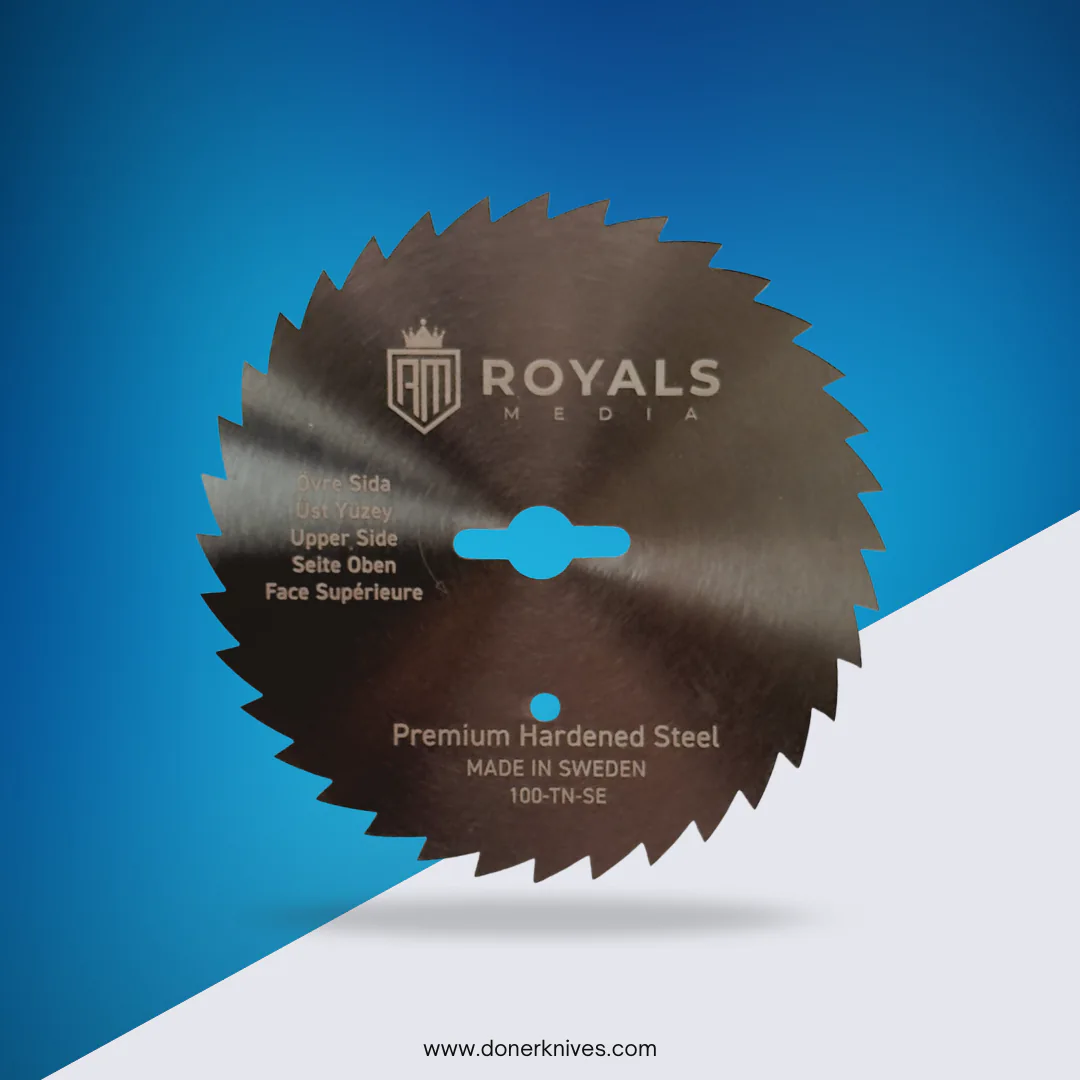
A circular doner knife blade is a steel disc, not a hand knife. The entire outer edge is the cutting edge, and the central hole is the only attachment point. When you mount the blade on your Universal machine, it is the machine's shaft that holds the disc in place – there is no handle, tip, or spine to speak of.
The cutting itself happens when the rotating disc is pressed against the meat. The blade's diameter determines how deep the cut will be and how large a piece of meat you can handle. That is why the diameter is always controlled by the machine, never by personal preference. A 100 mm blade simply does not fit on a machine built for 80 or 90 mm – it is a physical limitation, not a question of quality.
All blades in our range are made of hardened stainless steel. This means they can withstand repeated use without losing their edge prematurely, but it also means they should be washed by hand. The dishwasher's aggressive detergents attack the edge and significantly shorten its lifespan.
You choose between two edge types depending on how you work: smooth blades give an even, fine cut on more tender meat, while serrated blades are better when the meat is firmer or comes straight from the fridge. The geometry itself is the same – it is only the design of the edge that differs.
When you wonder whether a 100mm doner knife blade fits a Universal machine, the answer is no – Universal machines use 80, 90, or 140 mm. Anything else becomes a guess that can damage both the blade and the machine.
Universal machine blade diameters: 80, 90, and 140 mm
Universal machines are not a single model – the name hides an entire family of slicing machines where the blade diameter is locked to your specific machine's configuration. There are three main diameters: 80 mm, 90 mm, and 140 mm. There is no 100 mm variant for Universal, which is why the question of whether a "100mm doner knife blade fits a Universal machine" always gets the answer no.
80 mm is the standard on smaller machines from brands such as Ceylan, Gurden, and Potis. The blade sits close to the motor and provides a compact cutting unit – perfect for home use or smaller servings. Here you will find both 80mm Universal – Serrated and 80mm Universal – Smooth.
90 mm is the middle class and is used by Universal machines from Dost. It is a common diameter for those who cut larger volumes but do not want to step up to the large machines. Just like with 80 mm, there are both 90mm Universal – Serrated and 90mm Universal – Smooth.
140 mm is the large diameter, intended for heavier machines from Alkadur, IDM, Korkmaz, Atalay, and Potis. Here the mounting differs: the blade is bolted on through 2, 3, or 4 holes, depending on the brand. Korkmaz and IDM use 3 holes (140mm Universal – 3 hole), while Atalay requires 4 holes (140mm Universal – 4 hole).
So before you keep looking: measure your current blade. The diameter determines everything – and for Universal, 100 mm is simply not an option.
How to measure your old blade to find the right diameter
Measuring your old blade is easier than you think – and the only sure way to know which diameter your Universal machine requires. Since the question of whether a 100mm doner knife blade fits a Universal machine comes up often, the answer is no: Universal machines only take 80, 90, or 140 mm. Here is how to measure correctly.
Step by step – the measurement
- Remove the blade from the machine according to the manufacturer's instructions. Handle it by the edge – it is hardened stainless steel and sharp all the way around.
- Measure the diameter straight across the centre of the blade, from outer edge to outer edge. Use a calliper for precision; a tape measure often gives a margin of error of a few millimetres.
- Compare with the standard sizes: 80, 90, 100, 120, or 140 mm. If your blade measures exactly 80 or 90 mm, it is a Universal machine. If it measures 140 mm, you also need to count the holes.
- Count the mounting holes on 140 mm blades. Universal comes in variants with 2, 3, or 4 holes – 140mm Universal – 2 hole, 3 hole, or 4 hole.
- Check the centre hole: It should match your machine's shaft. Measure the inner diameter of the hole and compare it with the fit of the old blade – is it loose or tight?
Common mistakes to avoid
- Do not measure the edge – some blades have a serrated edge that makes the outer diameter vary. Measure from the outermost tip of the teeth.
- Do not guess based on the machine's brand. A Dost machine can take both 80/90 mm Universal and 90 mm Dost – it is the blade's dimensions that determine.
Unsure? Read our guide on how to know which blade size your machine needs or measure once more – it takes two minutes and saves you from buying the wrong blade.
Serrated or smooth blade – which should you choose?
When choosing between a serrated and a smooth blade, it is not about which is "best" in general, but about which type of meat you most often cut. Both variants are available in hardened stainless steel, so the durability is the same – the difference lies entirely in the design of the edge.
A smooth blade gives a clean, even slice without tearing at the surface of the meat. It is ideal for freshly grilled, tender doner meat that is still juicy and warm. The slices become thin and fine, and you get a professional presentation on the plate. If you choose a smooth blade for your Universal machine, for example 80mm Universal – Smooth or 90mm Universal – Smooth, you get maximum control over slice thickness.
A serrated blade is your best friend when the meat is firmer or comes straight from the fridge. The teeth grip the surface and cut through tougher fibres without mashing them. The result is even slices even of cold or pressed meat, and you avoid struggling with the blade. For those who work heavily with cold raw material, 80mm Universal – Serrated or 90mm Universal – Serrated is a safe choice.
Many chefs use both and switch depending on the day. Remember that the question of which blade fits a 100mm doner knife blade to a Universal machine is not relevant – the diameter is determined by the machine, not by the edge type. Start with smooth if you serve immediately, serrated if you prepare in advance.
Material and care: Hardened stainless steel and hand washing
All blades in our range – whether you are looking at an 80 mm Universal blade or a 140 mm with bolt mounting – are made of hardened stainless steel. This means the edge holds its sharpness for a long time and the blade can withstand the humid climate of a kitchen without rusting or discolouring. You do not need to oil it or treat it in any special way; the material takes care of itself.
The most important care tip is simple: wash by hand. Even though it is tempting to throw the blade in the dishwasher after a long service, it is a mistake. The dishwasher's aggressive detergent and high temperature attack the edge and make it dull prematurely. A hand-washed blade holds its edge significantly longer.
Wash the blade with warm water and a mild detergent immediately after use. Then dry it with a soft cloth. Avoid scrubbing the edge with steel wool or abrasive sponges – it damages the surface.
Remember that a blade that fits a 100mm doner knife blade to a Universal machine does not exist in our range, but the care is identical for all our diameters. Store the blade dry and protected when not in use, preferably in its original packaging or on a designated hook. With proper care, a hardened stainless steel blade will last for many years.
Step by step: Replace the doner knife blade on your Universal machine
Start by turning off the machine and unplugging it. Place a cutting board or a clean cloth on the table so the blade does not touch the surface when you loosen it.
1. Loosen the protective plate and the nut Most Universal machines have a threaded nut or a locking screw in the centre of the blade. Use the correct spanner – not pliers – to loosen it. At the same time, hold the edge of the blade with a towel so it does not spin along.
2. Pull the blade straight out Once the nut is loose, pull the blade straight off the shaft. If it is stuck, you can gently wiggle it from side to side. Look at how the blade is mounted before you remove it – this makes it much easier to put the new one back on.
3. Compare the diameter with your old blade Place the old blade on top of the new one. They should have exactly the same diameter and the same centre hole. If you have bought a blade that does not match – for example by searching for "100mm doner knife blade fits Universal machine" – you will notice it now. Universal machines only take 80, 90, or 140 mm, never 100 mm.
4. Mount the new blade Slide the new blade onto the shaft with the smooth side facing the meat. Tighten the nut properly with the spanner, but do not overdo it – over-tightening can damage the thread. Spin the blade by hand one full turn to ensure it sits straight.
5. Test run without meat Start the machine for a few seconds without meat. The blade should spin evenly without vibrations. Then wipe the blade with a damp cloth – never use the dishwasher, as it corrodes the edge. Done!
Troubleshooting: What to do if your machine is not in the table?
Is your machine missing from the table? Start by not guessing. Taking a chance on a blade with the wrong diameter or mounting can damage both the blade and the machine. An 80mm Universal – Serrated looks the same as a 90mm from a distance, but does not fit.
Always measure your old blade. You need three measurements:
- Outer diameter – measure straight across the blade's edge.
- Centre hole diameter – the hole in the middle that sits on the shaft.
- Mounting pattern – is it a keyhole, a round hole, or multiple bolts?
Feel free to send us a photo of the back of the blade if you are unsure. Then we can see immediately which type it is.
Common misconception: Many believe that the question of whether a 100mm doner knife blade fits a Universal machine has a simple yes or no answer. The truth is that the Universal series comes in 80, 90, and 140 mm – 100 mm is for Tandir machines. Even if the diameter happens to match, the centre hole differs.
Still cannot find the right one? Look at our 90mm Universal – Smooth as a reference for dimensions, but always measure your own blade before ordering. Correct dimensions guarantee safe and even cutting.
Frequently asked questions about 100mm doner knife blades and Universal machines
How do I know if 100 mm fits my Universal machine?
The short answer is that it does not. Universal machines from brands such as Alkadur, IDM, Korkmaz, Atalay, Ceylan, Gurden, and Potis use blade diameters of 80, 90, or 140 mm. A 100 mm blade is simply too small for the 140 mm mount and too large for the 80 and 90 mm mounts. The question of whether a 100mm doner knife blade fits a Universal machine therefore gets a no – you need to measure your old blade to find the right diameter.
Which brands use 100 mm blades?
100 mm blades are specific to Tandir machines. However, there are both serrated and smooth variants in 100 mm for Tandir, so you still have a choice in edge type – just not in diameter.
My blade is 100 mm – will it work anyway with an adapter?
No. Doner knife blades are mounted directly onto the machine's shaft and held in place by the centre hole or screw holes. There are no adapters that convert between diameters, and trying to adapt a wrongly sized blade is directly dangerous. A blade that is not perfectly centred will vibrate, cut unevenly, and can come loose during operation.
What is the difference between a serrated and a smooth blade?
A smooth blade gives even, thin slices – perfect for freshly grilled, tender meat. A serrated blade is better for firmer or fridge-cold meat, because the teeth tear through the surface without crushing the fibres. Both variants are available in 80 and 90 mm for Universal, so you do not have to compromise.
How do I measure the right diameter?
Measure the blade's outer edge straight across the centre – from one side to the other. Do this in two places to ensure the blade is not warped. Write down the measurement and compare it with 80, 90, or 140 mm. Also check the centre hole and the screw hole pattern – 140 mm blades come with 2, 3, or 4 holes.
My machine is not in the list – what do I do?
Always measure the old blade. The diameter, centre hole, and hole pattern determine which blade fits. Feel free to take a picture of the mount and send it to us – then we can help you identify the right model from the range. Never guess, because the wrong blade can damage both the machine and the meat.
Conclusion: The right blade for your machine – and why 100mm is not an option
Looking for a 100mm doner knife blade that fits a Universal machine is a common misconception – but the answer is clear: they do not. Universal machines are designed for 80, 90, or 140 mm blades, and the diameter is determined by the machine's shaft and protective cover, not by personal preference. A 100 mm blade simply does not fit, no matter how sharp it is.
Your main task is to identify your machine's mounting system. If you have a Universal with a keyhole mount, you measure the diameter of your old blade – either 80 mm for compact machines or 90 mm for slightly larger models. Both are available in smooth and serrated variants, and the choice is guided by the meat's temperature: smooth for tender, warm meat and serrated for firm or fridge-cold.
One final warning: do not confuse Universal with Tandir machines, where 100 mm is actually standard. Guessing your way forward costs both time and money. Always measure the centre hole and bolt pattern on your existing blade – if you have an older machine with a three- or four-hole mount, then the 140 mm Universal is the one. The right diameter is not a question of accessories, but of fundamental compatibility. Choose correctly from the start, and you will have a machine that works safely and efficiently for many years to come.