November 21, 2026
Döner Knife Blades for Jet Machine – Complete Guide
Introduction: Döner Knife Blades for Jet Machine
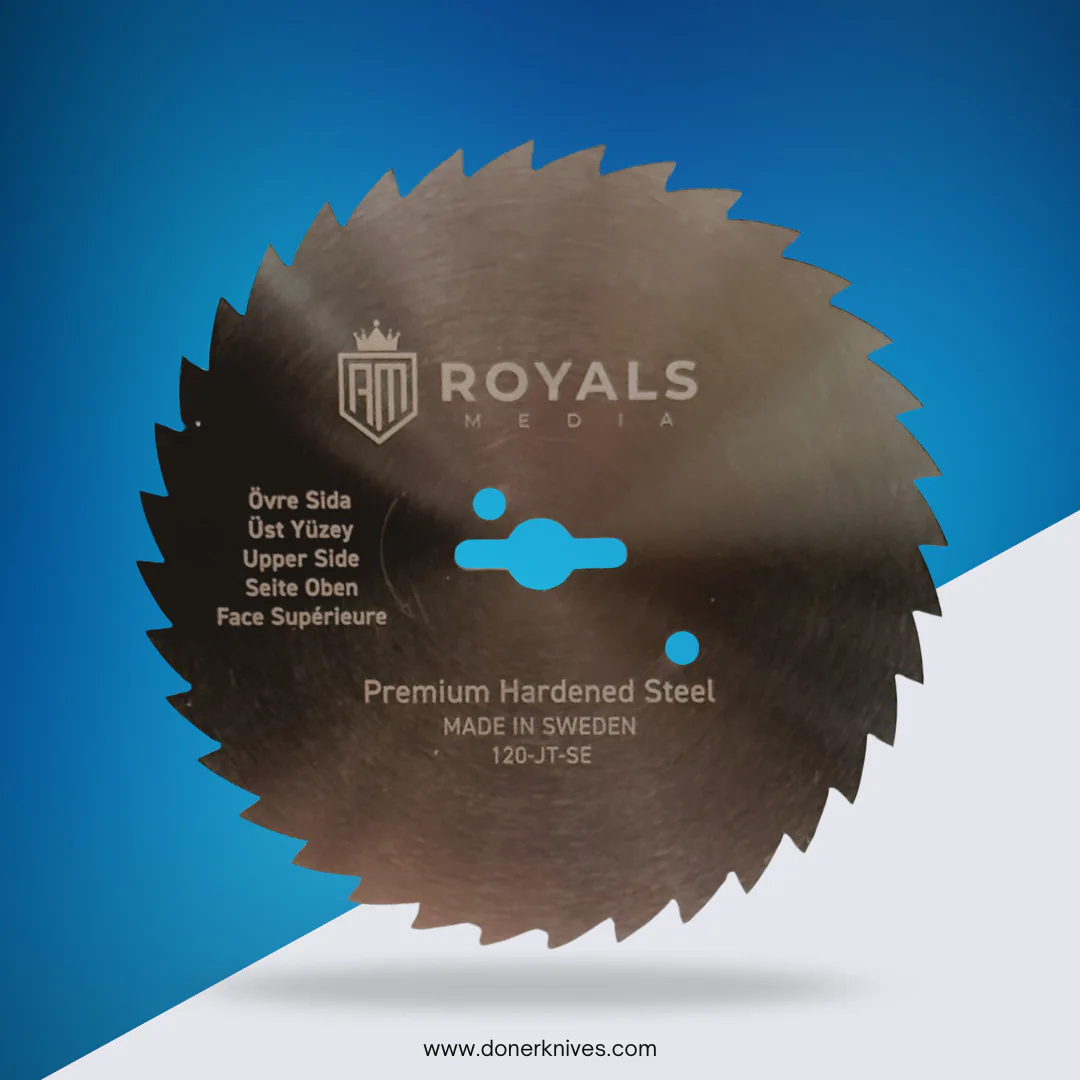
Choosing the right döner knife blade for Jet machine is not about personal preference – it's about precision. Your Jet machine is built for a specific blade with a 120 mm diameter, and using the wrong size gives you neither clean slices nor safe operation. The blade is a circular disc of hardened stainless steel, without a handle or point, where the entire circumference constitutes the cutting edge.
For Jet machines, there are two variants: serrated and smooth. The serrated blade is ideal for firmer or refrigerator-cold meat, while the smooth one gives more even, tender slices. Regardless of which you choose, the material is always hardened stainless steel – nothing else.
Before you buy a new blade, it's important that you understand how it is mounted. It is attached via the center hole, and the diameter is locked to 120 mm for your machine model. Always measure your old blade to ensure that the center hole and mounting pattern match.
In this guide, we go through everything you need to know: how to identify the right blade, how to replace it safely, and how to maintain it for a long lifespan. Let's start with the basics – so that your Jet machine always performs at its best.
How to Identify the Right Döner Knife Blade for Jet Machine
Finding the right döner knife blade for Jet machine is not about personal preference – it's about measurements. Jet machines use a blade with a 120 mm diameter, and that is the only option that fits. Before you order, measure your old blade to be sure. The diameter should be exactly 120 mm, and you also need to check the center hole. For Jet machines, it's a specific mounting that is not the same as Universal or Dost – so double-check that you choose the right model.
Here's a quick checklist:
- Measure the diameter – from edge to edge, straight across the middle. It should be 120 mm.
- Check the center hole – Jet has its own mounting. Compare with your old blade to see that the shape matches.
- Choose the edge type – a smooth edge gives even, thin slices. A serrated edge is better if you cut cold or firmer meat.
Once you know it's 120 mm and the right mounting, you choose between 120mm Jet – Smooth or 120mm Jet – Serrated. Both are made of hardened stainless steel and withstand the tough demands of daily use.
Are you unsure whether your blade really is for a Jet machine? Measure first. If the diameter is 120 mm but the center hole looks different than expected, take a picture of the mounting and compare it with the product images. Taking a chance with the wrong blade wastes both time and money – and can damage the machine. The right choice is in the details.
Serrated or Smooth Blade – Which Suits Your Jet Machine?
The choice between serrated and smooth blades is not about what is "best" in general, but about what type of meat you slice and how you prepare it. Both variants for your 120mm Jet – Serrated and 120mm Jet – Smooth are made of hardened stainless steel, so the durability is the same – it's the geometry of the edge that determines the result.
Choose a smooth blade if:
- You serve freshly grilled, juicy döner meat that should be sliced thinly and evenly.
- You want a clean, fine slice without ragged edges.
- The meat is at room temperature or warm when you slice it.
The smooth blade provides a pressure that cuts through tender meat without tearing the fibers. The result is elegant, even slices that look appetizing on the plate.
Choose a serrated blade if:
- You slice meat that is refrigerator-cold or semi-frozen.
- You have a tougher piece of meat or a lot of surface with a seared crust.
- You want a more aggressive grip that "saws" through instead of pressing.
The serration provides better grip on hard surfaces and reduces the risk of the blade catching or crushing the meat. The downside is that the slices can become slightly less smooth at the edge.
For most restaurants running classic döner with freshly grilled meat, we recommend a smooth blade. But if you often slice directly from the fridge or freeze your spit, the serrated option is a safer choice. Regardless of which – make sure you have the right diameter. For your Jet machine, it's 120 mm, and you'll find both variants in our range of döner knife blades for Jet machine.
Step-by-Step: Replacing the Döner Knife Blade on a Jet Machine
Start by turning off the machine and unplugging it. Lay the machine on its side so that the blade is easily accessible. Remove the protective cover or nut that holds the blade in place – use the right tool, often an Allen key or open-end wrench, depending on your Jet machine.
1. Loosen the old blade
Carefully unscrew the center nut clockwise or counterclockwise depending on the thread direction. Hold the edge of the blade with a cloth to avoid cuts. Pull the blade straight out from the shaft – do not wiggle it, as this can damage the mounting.
2. Inspect the shaft and holder
Before mounting the new blade, wipe the shaft with a clean cloth. Check that no food residue or grease remains. If the sealing ring is worn, replace it at the same time – a loose seal causes the blade to vibrate.
3. Mount the new döner knife blade for Jet machine
Take your new 120 mm Jet blade – either serrated or smooth – and fit the center hole onto the shaft. The blade should slide on without resistance. Screw the nut back on by hand until it catches, then tighten with the tool an extra quarter turn. Do not overtighten – this can cause the blade to warp.
4. Short test run
Plug the machine back in and run it for 5 seconds without meat. Listen for vibrations or scraping sounds. If everything sounds even, the replacement is complete.
Tip: Always keep the old blade as a spare until you know the new one sits perfectly. Wash the new blade by hand in warm water before first use – never in the dishwasher, as this damages the edge.
Care and Cleaning of Your Jet Blade
A döner knife blade for Jet machine is an investment that lasts longer if you take care of it properly. The most important thing you can do is to always clean the blade by hand. The dishwasher's aggressive detergents and high temperatures attack the edge and cause it to lose sharpness prematurely. Instead: rinse the blade in warm water immediately after use and dry it with a soft cloth.
Here's how to clean the blade:
- Remove meat residue – Use a soft sponge or brush. Avoid steel wool or abrasive sponges that can scratch the surface.
- Use mild dish soap – Let the blade soak for a few minutes if it's very greasy. Then dry it thoroughly.
- Lubricate if needed – A thin film of food-grade oil protects against moisture and keeps the blade in good condition between uses.
Since the blade is made of hardened stainless steel, it is durable, but not indestructible. Avoid dropping it and always store it in a protective case or in a safe place when not in use. If you notice that the sharpness deteriorates despite good care, it may be time to replace your 120mm Jet – Serrated or 120mm Jet – Smooth. Clean the blade after every session – then you'll get both better slices and a longer lifespan.
Compatibility: Jet vs Other Brands
When you're going to replace the blade on your slicing machine, it's easy to think that all round blades work. That's not the case. A döner knife blade for Jet machine is specifically adapted to Jet's mounting, and using a universal blade can result in poor fit or vibrations.
Jet uses its own mounting that is not the same as, for example, Dost or Universal. If you have a Jet machine, you should choose a 120mm Jet – Smooth or 120mm Jet – Serrated. For other brands, other blades apply:
- Dost (90 mm) uses Dost-specific or Universal.
- Tandir (100/120 mm) has its own mounting.
- Alkadur, IDM, Korkmaz take 140 mm Universal with 3 holes.
- Atalay takes 140 mm Universal with 4 holes.
- Ceylan, Gurden, Potis (80 mm) take Universal.
Don't see your brand in the list? Then measure the diameter, center hole, and hole pattern on your old blade – or send a picture of the mounting. Then you can compare with our guide for 140 mm universal blades or Dost-specific blades to find the right one. Taking a chance with the wrong brand unnecessarily wears on both the blade and the machine.
Why the Diameter Is Locked to 120 mm on Jet Machines
When you use a Jet machine, the diameter is not a matter of taste – it's locked to 120 mm by the design. This is because the machine's motor shaft, protective cover, and collection tray are exactly adapted to this size. A blade that is too small doesn't reach the motor properly, which causes vibrations and uneven slices. A blade that is too large risks hitting the cover or not being mountable at all.
That's why you'll only find 120 mm Jet blades in our range for this machine. It's a hardened stainless steel with a center hole that matches exactly JET's mounting. Whether you choose a smooth or serrated blade, the diameter is always 120 mm. Trying to use a different diameter is not just inefficient – it can be directly dangerous. So when you search for a döner knife blade for Jet machine, you know that 120 mm is the only correct size.
Safety When Handling Döner Knife Blades
A döner knife blade for Jet machine is extremely sharp – the entire circumference is a cutting surface, even when the blade is not in use. Therefore, always handle it as a tool in motion, never as a stationary disc.
- Always use protective gloves in cut-resistant material when mounting and dismounting. Thin cotton gloves provide no protection.
- Grip the blade at the center hole or with both hands on each side – never with your fingers along the edge.
- Let the blade come to a complete stop before opening the machine's guard. Wait until the rotation sound has ceased.
- Store the blade in its original packaging or on a flat surface with a protective edge when it's not in the machine.
- Check the blade for nicks or cracks before each replacement. A damaged blade can vibrate and throw meat pieces.
Always dry the blade thoroughly immediately after cleaning – moisture on the edge increases the risk of microscopic damage at the next use. By following these routines, you protect both yourself and extend the lifespan of your döner knife blade for Jet machine.
Frequently Asked Questions About Döner Knife Blades for Jet Machine
How often do I need to replace the döner knife blade for Jet machine?
There is no exact number of slices or months that works for everyone – it depends on how much you run the machine and whether you cut frozen or fresh meat. You should replace it when you notice that the slices become uneven, that the blade catches on the meat instead of gliding through, or that the surface becomes blotchy. A dull blade also puts more strain on the motor. As a rule of thumb: check the edge every week by running your finger gently along the edge (not across). If it feels rough or nicked, it's time.
Can I use a Universal blade on my Jet machine?
No. Jet machines have a specific mounting system that only matches 120mm Jet blades. Universal blades with keyhole mounting don't fit, and a Dost or Tandir blade has the wrong center hole. Trying to force the wrong blade can damage both the blade and the machine's shaft. Always measure the diameter of your old blade – if it's 120 mm and has Jet's mounting, it's right. If you're unsure, measure the shape of the center hole and send a picture to us, and we'll help you.
Serrated or smooth – what's the difference in practice?
A smooth blade gives clean, even slices on fresh or lightly chilled meat. A serrated blade is better when the meat is firm or just taken out of the fridge, because the teeth tear through the surface without mashing it. Many run with smooth as standard and switch to serrated during peak season when handling larger pieces. You'll find both variants for Jet: 120mm Jet – Serrated and 120mm Jet – Smooth.
Can I sharpen the blade myself?
It's possible, but it's difficult to get an even edge without the right equipment. A hand-sharpened blade often becomes uneven and gives poor slices. Since all our blades are made of hardened stainless steel, they lose sharpness slowly, but once they are dull, it's usually more cost-effective to replace than to sharpen. A new döner knife blade for Jet machine is an investment in consistent quality on every slice.
How do I clean the blade without ruining it?
By hand, in lukewarm water with mild dish soap. Dry immediately with a soft cloth. The dishwasher is absolutely forbidden – the detergent attacks the edge and can cause corrosion. Store the blade dry and protected when not in use.
Conclusion: Invest in the Right Blade for Your Jet Machine
You'll notice immediately that the right blade makes all the difference in both quality and work pace. A dull or incorrectly mounted blade wears on the meat, gives uneven slices, and forces you to stop the machine unnecessarily. By choosing a 120mm Jet – Smooth, you get a precise, even cut that suits freshly grilled, tender meat perfectly. If you prefer to cut colder or firmer meat, the serrated option 120mm Jet – Serrated is a better choice – it grips the surface and gives control without crushing the fibers.
Investing in the right döner knife blade for Jet machine is not just about sharpness, but about compatibility and durability. A hardened stainless steel blade in the right diameter lasts longer, protects the motor, and gives you a professional result every day. Always measure your old blade or send a picture of the mounting if you're unsure – then you'll get the right part the first time. Your machine deserves nothing less.