
September 27, 2026
Spare Blade Guide for Tandoor Doner Machines
Spare Blade for Tandoor Döner Machine: The Right Choice and Usage Guide
Choosing a spare blade for your tandoor döner machine is a critical decision that directly affects both the quality of the meat and the lifespan of your machine. A wrong blade can cause your döner not to be cut properly, the meat to shred, and even strain the machine's motor. In this guide, you will find everything you need to choose the right blade, with clear information that will prevent you from buying the wrong product.
First, let's clarify: These blades are not hand knives; they are circular steel discs mounted onto the shaft of your döner machine via the hole in their center. The cutting edge is the entire circumference of the disc, and the diameter is determined by your machine's production capacity. Diameters ranging from 80 mm to 140 mm are available; however, this size depends on your machine's design, not your preference. There are 17 different models on the market, each compatible with specific machine brands. Therefore, instead of assuming "it fits any machine," you need to know your machine's brand and your current blade's measurements to find the correct fit. Now, let's examine step by step how to make this choice correctly.
What is a Tandoor Döner Machine Blade and How Does It Work?
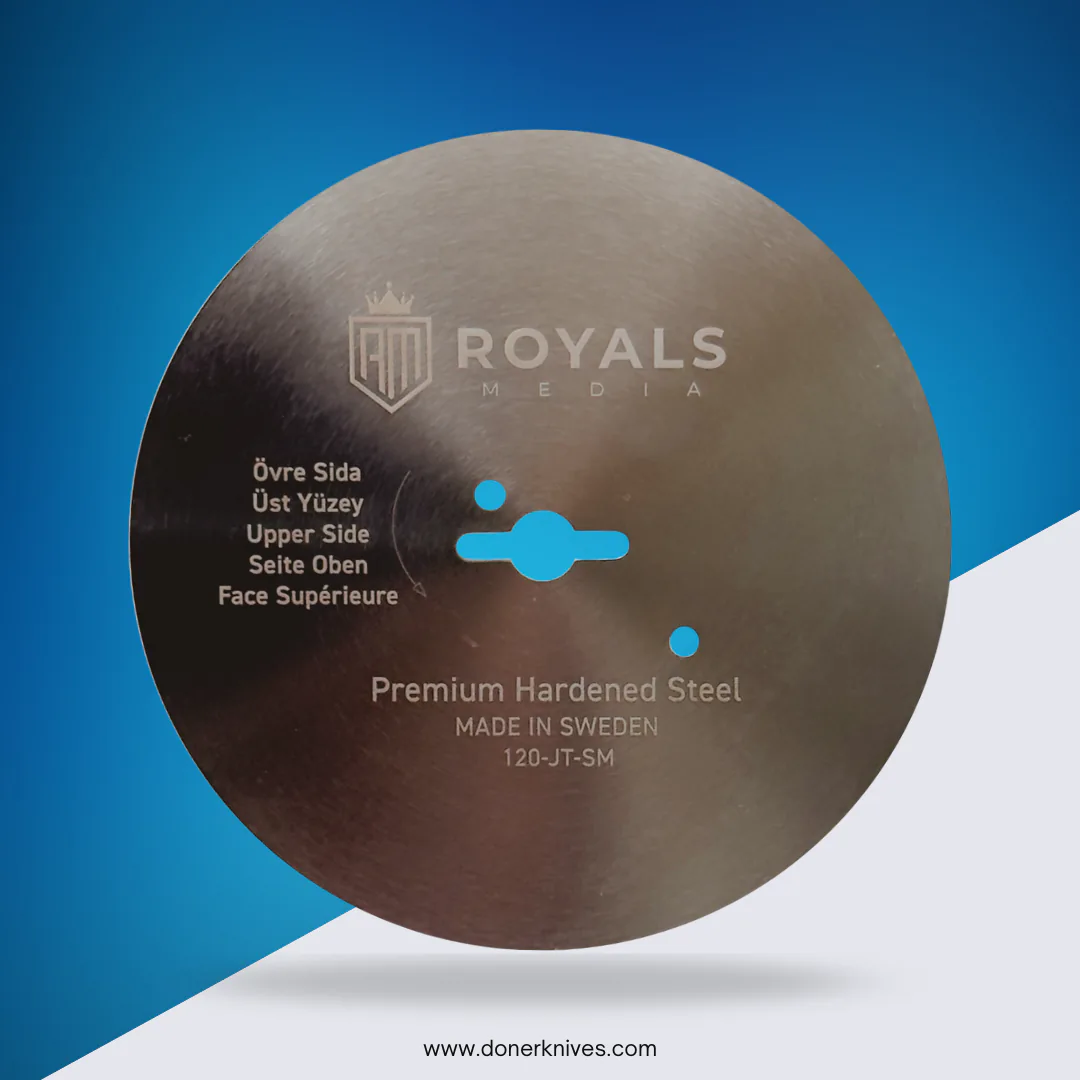
A tandoor döner machine blade is not a hand-held knife; it is a circular, steel disc mounted onto the machine's motor. It has no handle, tip, or spine; its entire circumference acts as the cutting edge, and it is secured to the shaft through the hole in its center. The rotating meat is cut into thin, even slices thanks to this rotating disc. The diameter of these discs depends entirely on the machine model; options include 80, 90, 100, 120, and 140 mm. It is mandatory to choose the diameter suitable for your machine; otherwise, the blade won't fit the shaft or won't provide a safe cut.
All blades are made from hardened stainless steel. This material ensures longevity under heavy use and resistance to rust. The blade's mounting method also varies by brand; different systems are used, such as keyhole (Universal), round center hole (Dost), or brand-specific connections (Jet and Tandır). The 140 mm models are manufactured with 2, 3, or 4 holes.
When choosing the right blade, you should pay attention not only to the diameter but also to the type of cutting edge. Serrated edges are ideal for meat that has just come out of the refrigerator or is firmer in texture, while smooth edges offer softer, more uniform slicing. Therefore, when looking for a spare blade for your tandoor döner machine, you need to correctly identify your machine's brand, your current blade's diameter, and the arrangement of the mounting holes. If you are unsure, measuring your old blade or examining a photo of the attachment point is the most reliable method.
How to Determine the Right Blade for Your Tandoor Machine?
Finding the right blade is easier than you think; all you need to do is check three basic factors in order: diameter, mounting type, and edge structure. If you determine these three correctly, your chances of error in choosing a spare blade for your tandoor döner machine are almost zero.
1. Determine the Diameter (Your Machine Tells You)
The blade's diameter depends entirely on your machine's shaft structure; it doesn't change based on personal preference. Our production range is limited to 80, 90, 100, 120, and 140 mm. If you know your machine's brand, your job is easy:
- Dost machines: 90 mm or 120 mm Dost blades
- Jet machines: 120 mm Jet blade
- Tandır machines: 100 mm or 120 mm Tandır blade
- Alkadur, IDM, Korkmaz brands: 140 mm Universal (3-hole)
- Atalay machines: 140 mm Universal (4-hole)
- Ceylan, Gurden, and Potis machines: 80 mm Universal
If your machine isn't on this list, don't guess. Remove your old blade and measure it with a ruler: note the diameter, the width of the center hole, and the number of mounting holes. If you're unsure, taking a photo of the mounting area and sending it to us is the most guaranteed way.
2. Check the Mounting Type
The blade is not a hand-held tool; it's a steel disc that fits onto the shaft through its center. The mounting type is divided into three:
- Keyhole (Universal): Has a single large hole and a small slot next to it. It's standard for 80 mm and 90 mm Universal blades.
- Round center hole (Dost): Has a flat, wide center hole that fits directly onto the shaft.
- Bolted mounting (140 mm): The blade is secured to the machine with 2, 3, or 4 bolts. Be sure to check the number of holes: one of the 140mm Universal – 2-hole, 3-hole, or 4-hole options will fit you.
3. Choose the Edge Type
The final step determines your slicing performance. If you slice meat at room temperature and soft, a smooth edge is ideal; it gives clean, even slices. If your meat is refrigerator-cold or has a firmer texture, a serrated edge grips the surface for a cleaner cut. For example, for the 120 mm Tandır, both serrated and smooth options are available.
All our blades are made of hardened stainless steel; you don't need to make a choice in this regard. Just determine the correct diameter, the correct mounting, and the edge type that suits you; the rest is easy.
Tandoor Machine Compatibility Chart: Which Blade Fits Which Machine?
Which blade does your machine model accept? Here's a quick compatibility chart for the most common brands:
| Machine Brand | Compatible Blade |
|---|---|
| Dost | 80/90 mm Universal, 90 mm Dost, 120 mm Dost |
| Jet | 120 mm Jet |
| Tandır | 100 mm Tandır, 120 mm Tandır |
| Alkadur, IDM, Korkmaz | 140 mm Universal (3-hole) |
| Atalay | 140 mm Universal (4-hole) |
| Ceylan, Gurden | 80 mm Universal |
| Potis | 80 mm Universal, 140 mm Universal |
Important Note: This chart is brand-based only. Different generations within the same brand may have different mounting holes. Therefore, the match in the chart alone is not sufficient.
The safest way to guarantee the correct fit: Remove your old blade and measure its diameter (80, 90, 100, 120, or 140 mm) and the number of mounting holes (2, 3, or 4). For example, the 120mm Tandır – Serrated model fits the vast majority of Tandır brand machines; however, we still recommend taking measurements.
Cases without compatibility guarantee: If your machine is not in the chart or you're unsure about the measurements, take a photo of the old blade showing the mounting surface. This way, your chances of error in choosing a spare blade for your tandoor döner machine drop to zero.
Additionally, in some machines, options like the 90mm Universal – Smooth are available in 90 mm and 80 mm sizes that can be installed directly without any modification. These models are ideal for replacement requiring no modification. When in doubt, always measure; the correct diameter and hole pattern are the key to safe, vibration-free operation of the blade.
Serrated or Smooth? Choose the Right Edge Type
One of the most critical decisions when choosing a spare blade for your tandoor döner machine is the type of cutting edge: serrated or smooth? This choice directly affects the texture of your meat, slice thickness, and your machine's performance. Both types are made from hardened stainless steel; the difference lies in the cutting mechanism provided by the toothed structure.
Smooth Blades Smooth-edged blades consist of a completely flat steel disc. This design yields excellent results, especially with cooked and tender meats. As the blade glides over the meat, it cuts cleanly without crushing the fibers; this allows you to achieve thin, even slices. If you want to present your döner in classic, traditional, and elegant slices, a smooth blade is the right choice for you. For example, the 100mm Tandir – Smooth model is ideal for this type of performance.
Serrated Blades The saw teeth on the edge of serrated blades work on a different cutting principle. These teeth bite into and grip the meat's surface, providing a significant advantage especially when cutting meat that has just come out of the refrigerator, has a hardened exterior, or is fatty. They don't slip on slippery surfaces and cut more easily with less pressure. If you marinate and rest your döner in advance or work with cold-served meats, a blade like the 120mm Tandir – Serrated model will make your job easier.
In summary, the decision depends entirely on your usage habits. Choose a smooth blade for fresh and hot meat, and a serrated blade for cold or firm meats.
Hardened Stainless Steel: Material and Maintenance
Hardened stainless steel is the most critical factor when choosing a spare blade for your tandoor döner machine. This alloy undergoes a special heat treatment to be both resistant to rust and able to maintain its sharpness for a long time even under heavy use. The continuous and even slicing of tandoor meat depends directly on this degree of hardness in the blade. While counterparts made from softer steel dull after a few uses, hardened stainless steel blades last much longer with proper care.
The most important rule in maintaining these blades is to never wash them in the dishwasher. Dishwasher detergents chemically attack the blade's cutting edge, degrading the hardened structure and causing premature dulling. Instead, simply wash the blade by hand with warm water and a soft sponge after each use and dry it immediately. Additionally, after removing the blade from the machine, avoid leaving meat residue or salt deposits on it, which prevents surface scratching and the risk of rust. To protect the sharp edge, be careful not to let the blade come into contact with other metal equipment. These simple steps will maximize the performance of your tandoor döner machine and the lifespan of the blade.
Step-by-Step Blade Replacement Guide
Blade replacement is a simple process that takes minutes when done correctly. However, incorrect mounting can damage both the blade and the machine's motor assembly. By following the steps below, you can safely complete the replacement of a spare blade for your tandoor döner machine.
Before You Begin: Safety and Preparation Be sure to unplug the machine. Since the döner blade is a sharp disc, we recommend wearing protective gloves. Prepare the appropriate wrench to loosen the nut or bolt on the old blade. Most models have a central shaft nut or a 2-3-4 hole bolt system.
Step 1: Remove the Old Blade Loosen the central retaining nut by turning it counterclockwise. The blade may be tightly seated on the shaft; gently wiggle it side to side and pull. If it's stuck, try gently prying it up from underneath with a screwdriver. Never use a hammer — this can bend the shaft.
Step 2: Check the Fit of the New Blade Ensure that the center hole and bolt spacing of the new blade match the shaft on your machine exactly. For example, if your machine is a Dost brand, you should choose one of the 90 mm or 120 mm Dost blade models. If your machine isn't in the compatibility chart, measure the diameter and hole pattern of the old blade to compare.
Step 3: Mount the New Blade Place the blade onto the shaft with the cutting edge facing outward. The direction of the cutting edge may vary depending on the machine's rotation direction; usually, there is an arrow indicator on the blade. This arrow shows the machine's rotation direction, and if installed incorrectly, you won't be able to slice the meat properly.
Step 4: Secure and Test Tighten the nut or bolts in a crisscross pattern, one by one. All points must be tightened equally; otherwise, the blade will wobble and cause vibration. Finally, turn the blade by hand to check that it rotates. Before plugging the machine back in, ensure all connections are tight.
Important Note: If you hear a slight sound when you first start the machine after installing the blade, this is normal. However, if there is friction or vibration, review the mounting again. Remember: models like the 100 mm Tandır or 120 mm Jet work on the same principle, only their securing methods differ.
When Should You Replace Your Blade?
Working with a dull blade both ruins the appearance of the meat and significantly slows down your service speed. So, how do you know when it's time to buy a spare blade for your tandoor döner machine? The clearest sign is when the meat isn't cut cleanly during slicing and the blade crushes and tears the meat. If you're getting jagged, crumbling pieces instead of thin, even, smooth slices, your blade has done its job.
Another important indicator is motor sound and strain. A dull blade crushes the meat instead of cutting it, causing the machine's motor to work harder than normal and the humming sound to increase. Additionally, if you remove the blade and visually inspect it and notice visible nicks or wear marks on the cutting surface, this also indicates it's time for a replacement.
When you notice these signs, it's best to replace the blade directly rather than trying to repair it. Sharpening can disrupt the blade's balance and cause vibration during rotation. With daily heavy use, the blade's lifespan typically ranges from a few weeks to a month. To extend this period, always wash the blade by hand and store it dry. Remember, a simple blade replacement done at the right time directly affects both the quality of the meat and the efficiency of your business.
Frequently Asked Questions
How Do I Replace My Tandoor Döner Machine Blade?
Blade replacement varies depending on your machine's model, but generally, it's sufficient to remove the central nut or screws, take out the old blade, replace it with a new one, and tighten it again. However, the best approach is to follow the instructions in your machine's user manual. When installing the blade, make sure the cutting edge faces the correct direction; otherwise, you won't be able to slice the meat properly.
Which Blade Fits My Tandoor Machine?
The most critical factors determining compatibility are the blade's diameter, center hole, and the arrangement of the mounting holes. If you know your machine's brand, you can examine brand-specific models like 80mm Universal, 90mm Dost, or 120mm Tandir. However, if your brand isn't in the chart, removing your old blade and measuring its diameter, center hole, and screw holes is the most guaranteed way. If you're unsure, taking a photo of the mounting area and sending it to the seller will also help you make the right choice.
Should I Use a Serrated or Smooth Blade?
This depends entirely on the condition of the meat you'll be slicing. For meat at room temperature that has been rested, a smooth blade gives the cleanest and thinnest slices. For firmer-textured or refrigerator-cold meat, a serrated edge grips without tearing. You can test both options to determine which suits your usage habits best.
How Do I Prevent My Blade from Dulling?
One of the most important points to consider when choosing a spare blade for your tandoor döner machine is maintenance. All our blades are made from hardened stainless steel and are long-lasting. However, washing them in the dishwasher quickly dulls the cutting edge due to the abrasive effect of the detergent. Therefore, always washing your blade by hand with warm water and a soft sponge and drying it immediately is the golden rule for maintaining its sharpness.
When Should My Blade Be Replaced?
If you notice the meat tearing, not cutting cleanly, or the blade catching on the meat during slicing, your blade's sharpness has diminished. Additionally, if there are visible nicks, bends, or rust on the blade, you should replace it immediately for hygiene and performance reasons.
Conclusion: Efficient Slicing with the Right Blade
The right blade directly determines the performance of your tandoor döner machine. Choosing a compatible model ensures homogeneous slicing of the meat, prevents unnecessary strain on your motor, and avoids time loss in your business. If you know your machine's brand (like Dost, Jet, Tandır), you can directly choose the compatible blade. If you're unsure, measuring your current blade's diameter and the number of center holes is the safest way to find the right product.
Remember that every blade is made from hardened stainless steel and should be washed by hand. The dishwasher dulls the sharp edge. Regular maintenance and timely replacement are essential for efficient slicing. An old, dull blade both crushes the meat and strains the motor.
Choose the one that best suits your business's needs: 120mm Tandır – Serrated or 100mm Tandır – Smooth. With the right spare blade for your tandoor döner machine, you gain both flavor and speed.